One evening on Instagram: four viral fakes, and what our checker said about each
On the evening of November 17, 2026 we scrolled an ordinary Instagram feed and stopped at every post that looked too strange to be true. It did not take long. We took screenshots — exactly what you can do on your phone — and ran each one through AI Analyzer. Here are the four we found, the answers we got, and what fact-checkers say.
Published 2026-11-18 · AI Analyzer team
How we tested: each answer below is what AI Analyzer returned on November 18, 2026 for the screenshot next to it (without our red stamp; account names blurred). We did not edit the answers. If you check the same picture, your number can differ by a few points.
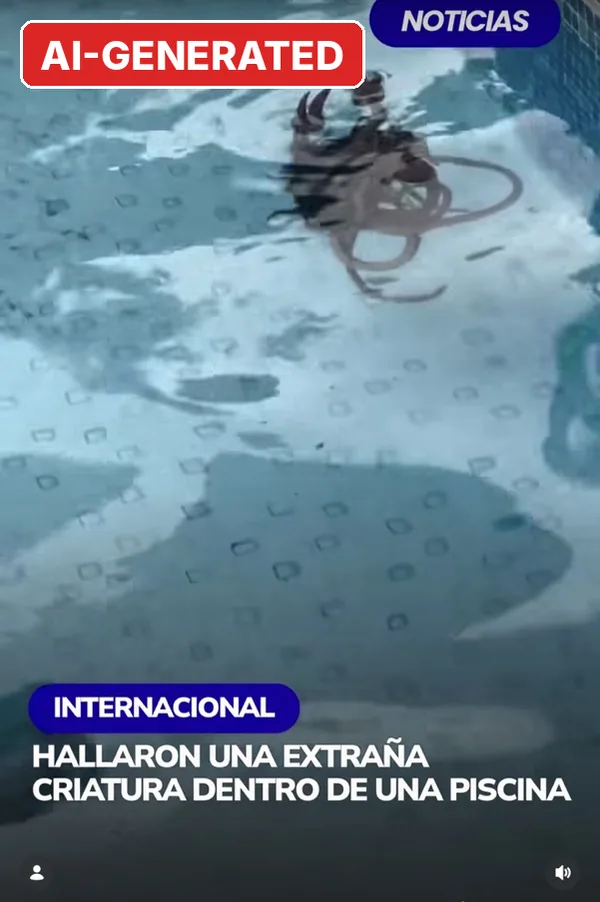
1. “They found a strange creature inside a swimming pool”
AI Analyzer’s answer
Likely AI-generated
AI probability: 62%
The headline claims a strange creature was found inside a swimming pool, which would be a major unexplained event if true. The figure in the pool has horn-like protrusions and coiled tentacle shapes that look like a digital rendering or illustration pasted onto the pool footage, with flat shading and no convincing water interaction. The scene itself is implausible, so this looks like a fabricated or AI-generated news image rather than real footage.
Automated estimate, not proof. Not an expert or forensic examination and not evidence for legal use. No detector is 100% accurate.
The post is dressed as news: a “NOTICIAS” badge, an “INTERNACIONAL” banner, a serious headline. The clip looks as if someone filmed their own pool on a phone. What swims in it is a dark creature with horns and coiling tentacles.
What is behind it. The creature looks like the “Panama alien”, also called Venomkin — a series of videos from a TikTok account that went viral in September 2025 and that meme trackers describe as purportedly AI-generated. The creator never said whether they were real. Now the same kind of creature is back, this time with a news logo on top.
The tell. Look at the water around it: no splash, no ripples, no distortion where the body meets the surface. Anything that really moves in a pool pushes water around.
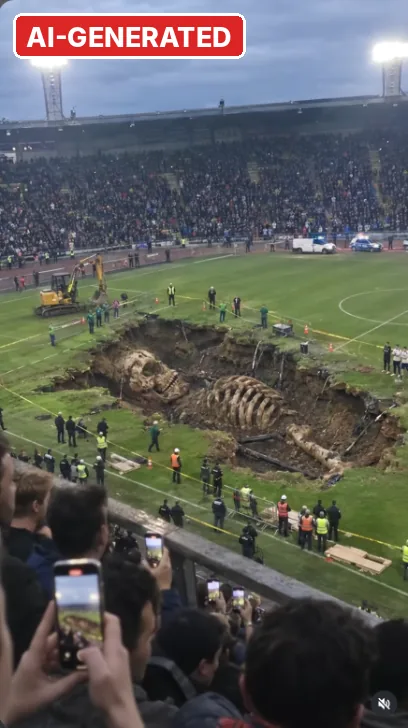
2. A giant skeleton under a football pitch
AI Analyzer’s answer
Likely AI-generated
AI probability: 62%
The scene shows a huge ribcage and vertebrae apparently pulled from a sinkhole in a football pitch, a claim that contradicts known science and would be a major news event if true, so the content itself is implausible. The bones look unnaturally smooth and evenly arranged, and the surrounding crowd, phones, and pit edges have the kind of coherent-but-soft detail typical of AI-generated footage.
Automated estimate, not proof. Not an expert or forensic examination and not evidence for legal use. No detector is 100% accurate.
A stadium full of fans, floodlights, an excavator, workers in hi-vis vests — and in the middle of the pitch a sinkhole with a ribcage the size of a bus. Everyone in the stands is filming on their phones, and that is exactly what makes it feel real: it looks like fan footage, not a press photo.
What is behind it. Giant-skeleton pictures are one of the oldest hoaxes on the internet (we explained them here). AI video has simply moved them from desert digs into places people know. A find like this in a full stadium would be on every news site in the world within the hour. It is on none.
The tell. The bones are smooth, pale and evenly spaced, with no soil in the joints. A real skeleton coming out of wet ground would be dark, broken and half-buried.
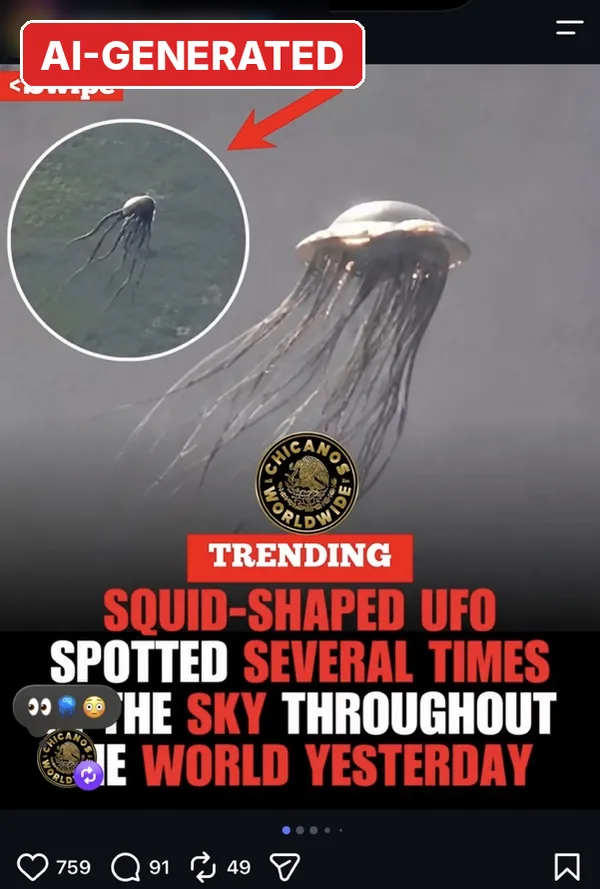
3. “Squid-shaped UFO spotted several times in the sky throughout the world”
AI Analyzer’s answer
Likely AI-generated
AI probability: 62%
The main image shows a translucent, jellyfish-like object with dangling tentacles drifting in an overcast sky. It looks like a computer-generated render: the outline is smooth and symmetrical, the tentacles have uniform, stylized texture, and the inset shows the same shape against a flat landscape with no convincing lighting or scale cues. The headline claims a worldwide sighting of a squid-shaped UFO, which is an extraordinary, unverified claim with no credible source or news coverage behind it.
Text inside the image: AI probability 62%.
Automated estimate, not proof. Not an expert or forensic examination and not evidence for legal use. No detector is 100% accurate.
This one uses a common trick: put a blurry clip in a small circle, then show a big, sharp, glowing “close-up” next to it, so your eyes fill in the gap. The headline adds urgency — “TRENDING”, “throughout the world”, “yesterday”.
What is behind it. Blurry “sky jellyfish” clips really did circulate this month. The best known was filmed in Anchorage, Alaska, in June; the explanations in the coverage point to an octopus-shaped kite or a high-altitude balloon, and nothing extraterrestrial has turned up. The big, crisp jellyfish in this post is the part our checker flagged as computer-generated.
The tell. Real sightings get worse the closer you look — blurrier, grainier, further away. When a “UFO” post hands you a sharp, perfectly lit close-up, ask who took it, and with what.
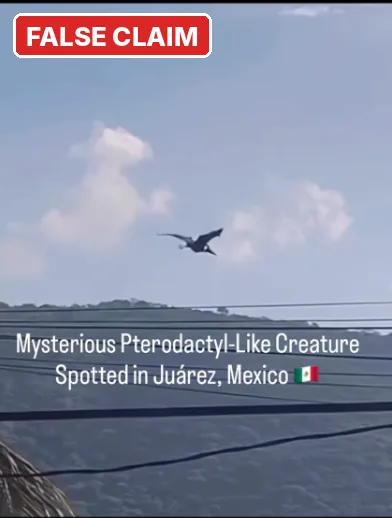
4. A “pterodactyl” over Ciudad Juárez — when the headline is the fake
AI Analyzer’s answer
Likely real
AI probability: 11%
The image shows a large dark bird with outstretched wings flying across a hazy sky above forested hills and power lines, with coherent lighting and no sign of synthetic artifacts. It plausibly shows an ordinary real bird, such as a heron, pelican, or vulture, so the caption's claim of a pterodactyl-like creature is the misleading part.
Automated estimate, not proof. Not an expert or forensic examination and not evidence for legal use. No detector is 100% accurate.
This is the honest case, and an important one. Our checker did not call this frame AI-generated. It saw a large bird — it suggested a heron, a pelican or a vulture — and said plainly that the caption is the misleading part.
What fact-checkers found. What the Fact found that the flying shape matches a great blue heron, and that the video mixes real low-quality clips with AI-made pterosaur imagery. Snopes rated the Instagram clip it examined as fake, generated or edited with AI. The head of Civil Protection in Ciudad Juárez said the videos were digital entertainment with no real basis.
The lesson. One frame does not show everything. In the moment our checker looked at there was only a bird — which is also what the experts found under the hype. When a post makes a claim that would rewrite science textbooks, doubt the claim first, whatever the picture looks like. For videos, check the whole clip in the app: it looks at several frames, not one.
What all four have in common
- A claim that would be world news. A giant’s skeleton, a living pterosaur, an alien in a pool. If any of it were real, you would read about it everywhere, not in one reel.
- The look of an ordinary phone video. Shaky, low resolution, “filmed by someone who happened to be there”. Modern AI video imitates exactly that.
- A news costume. “NOTICIAS”, “TRENDING”, “INTERNACIONAL”, a logo, a verified badge. None of these is a source.
- No names. No place you can check, no exact date, no person who filmed it, no scientist, no official.
- Huge numbers. Tens of thousands of likes and shares make a post look confirmed. They only show that it is entertaining.
How AI Analyzer protects you here
The point is not to win an argument in the comments. It is to stop before you share something — or before a page that started with “wonders” sends you to a miracle cure, a “government grant” or a crypto giveaway.
- It checks the picture. It looks for signs of AI generation and gives you a number, not just a yes or no.
- It reads the text in your screenshot. Headlines and captions are checked too, and it tells you when the claim does not match the picture — like the “pterodactyl” that is a bird.
- It explains why. Every answer comes with reasons in plain words, so you can look for yourself.
- It takes seconds. Take a screenshot, add it to the app, read the answer. The app gives you 3 free checks every day.
It is honest about its limits, too. The result is an estimate, not proof, and no detector is 100% accurate. “Likely real” means no clear signs of AI were found — not that the story is true. That is why it reads the caption as well, and why the last step below matters.
Check the next one in 20 seconds
- Take a screenshot. Picture and caption together.
- Check it. In the AI Analyzer app, or right here with the screenshot AI detector.
- Search the claim. Type the headline and the words “fact check” into a search engine. The big ones are usually explained within a day or two.
Sources
- Snopes (via Yahoo News): Don’t fall for alleged footage of pterodactyl flying in Mexico (November 2026)
- What the Fact: Did a video show a living pteranodon flying over Chihuahua, Mexico?
- ABC Noticias: Ciudad Juárez Civil Protection on the “pterodactyl” video (in Spanish)
- Know Your Meme: Panama Alien / Venomkin
- Primetimer: Is the Panama meteorite alien real or fake?
- IBTimes UK: the “sky jellyfish” over Anchorage may be an octopus kite
- IBTimes UK: experts’ leading explanation for the Alaska “jellyfish” is a high-altitude balloon
About this article: the posts shown were publicly visible on Instagram on November 17, 2026. We show cropped screenshots, with account names blurred, for news reporting, commentary and education. The checker answers are automated estimates — not proof and not an expert finding about any post or person; what is known about each story comes from the fact-checkers linked above. Instagram is a trademark of Meta Platforms, Inc.; AI Analyzer is not affiliated with or endorsed by Meta. If a post shown here is yours and you want it removed, write to [email protected].
Check a picture yourself — one free check
Your image is sent for analysis only when you add it. We keep the result, not the picture. Privacy
More case studies
Related
Check the next one in the app
3 free checks every day on Android, iPhone and in your browser.